


Page 13 - B2B 8 to 13
P. 13
 In the previous Section of the Part on Modelling Structures David McLaughlin discussed scratch-building structures where proprietary kits or ready-built structures were not available. In this Section we discuss what is available to build (or simply plant on your layout if ready-built), what sources there are and how you can modify them to better suit your chosen prototype if you are modelling one. The following comments and ob- servations are based on my own direct experience of building structures for my layouts in HO and N, both past and present. I make only side references to O and S scales.
Choosing and building the right structures for your layout will not only help set the right period but also the right location and even, perhaps, the right railroad. One respected modeller once said that if you remove all the locomotives and rolling stock you should be able to tell the location and era of a model by looking at its infrastructure, the buildings and their environs. In this Section we will look at both railroad structures and others that line the side of the tracks, including most importantly rail-served industries.
Where to start looking
A good starting point is the real thing – see what is around the railroad where you are modelling. Trips to the chosen area
of your modelling project in the USA or Canada are the ideal. Alternatively, phone a friend who is going. If you cannot do
that there is the internet and websites such as Google Earth
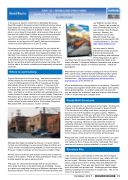
or Google Maps and its “streetview” option. I have used all three...and taken a call from a member who wanted photos of a certain location he knew I would be at on my holiday. Downtown Wenatchee got a real photo session in 2015 when my travelling companion who is planning a Great Northern layout set in that locale suffered a total camera failure. Photo below:Downtown Wenatchee WA, old structures, modern vehicles.
Although this might be stating the obvious, it is worth reiterat- ing that any old buildings you see around today (and there are many) will be comfortable being modelled in most railroad eras. However, modern buildings will only be good in modern times.
Another source of photos and images of structures is reference books on the subject. There are many publications which cover lineside aspects as well as passing trains.
That said, we cannot travel through time to be sure what is there today was there in the period you are modelling. Howev- er, a place you might start looking is a Walthers catalogue in the Structures section. There you will find all the manufacturers that
use Walthers as their whole- saler. Clearly it will include the main USA manufacturers but it also includes many European ones too. Beware, the architecture can be very different though there are exceptions (Leavenworth, WA is totally Bavarian!). See also https://www.walthers.com/ .
You also need to identify lineside/rail-served structures that are railroad-specific. Depot buildings and switching/ interlocking towers are good
examples that will eshew different architectural styles as be- tween railroads. Fortunately Walthers themselves now produce railroad structures specific to individual railroads - check the descriptions.
Alternatively if you do not have a catalogue to hand, HO mod- ellers can browse a website like that at Model Junction where you can look at all structure kits they have in stock, listed by manufacturer: http://www.modeljunction.info/estore/index. php?cPath=25_34 for HO kits etc.
All kits available have varying degrees of complexity. Some kits will simply click together whilst others may require some cutting before gluing together. In addition some laser-cut wood kits may be classed as “craftsman” level and require a high degree of skill in model-making to complete them.
Ready-Built Structures
In some respects this is a new feature of our hobby. It follows the change from the Athearn Blue Box concept to “Ready-To-Roll”
in the locomotive and rolling stock arena, requiring no construc- tion at all, not even the addition of quality couplers. Walthers introduced the idea as “Built-ups” and also in the Trainline range, along with Model Power and Woodland Scenics who have also done it. Such structures come in appropriate plastic colours requiring no painting. However in both cases the choices are somewhat restricted, not helped by the present-day trend of limited production runs. Very few railroad structures seem to be available in this format but there are large numbers of offline in- dustries. Clearly you can build a townscape very quickly this way but it comes at a price since the kit versions will be cheaper.
Ready-built also covers the vast array of “accessories” you need on a railroad, such as track bumpers, signals, instrument cabi- nets, lights etc. None of these should be overlooked. How many yards do not have any lighting modelled? or streets lit etc?
Structure Kits
I, like many of you, was weaned on Airfix kits, those magical bags of plastic parts that could transform your railway with half an hour’s graft. Whether it was a station building or a news- stand, a signal box or level crossing, they all breathed life into the model railway. There was also back in the 1960s Super- quick kits made from printed card. Hamblings produced paper sheets of buildings to be mounted on stouter card. This is how many of us learned our tricks.
        October 2017 - ROUNDHOUSE 15


