


Page 33 - B2B 8 to 13
P. 33
       Back2Basics Back2Basics
Back2Basics
PART 13 – Scenery
SectSioencPt2iAo:RnTTr1e1:e3As–n, GSInrcaetrsnosedaruyncdtiDonetails
Section 2: Trees, Grass and Details
By Kathy Millatt MMR
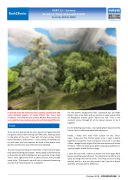
  You’ve built your baseboards, laid your track and now you are staring at some clean pieces of plywood or foam and wondering where to go next! Scenery can feel very daunting to a newcomer but is actually very forgiving. It’s easy to correct mistakes and redo sections so the best advice is to give it a go and not worry.
Basics
The first thing to do is consider your model and where it is based. Is it desert or forest, flat or mountainous, rocky or muddy, arid or wet? All of these impact on your scenery and how you build it. The good news is that the basics are the same regardless.
I always think of my scenery in terms of foreground, midground and background. I try and make my foreground the most detailed. Viewers will be drawn to this first and naturally assume that the rest of the layout is as detailed.
In reality, everything blurs with distance and you cannot see weeds or details after a certain point. We can use our scenery to add a feeling of depth that mirrors reality. My backgrounds are therefore more generic, quicker to model and less detailed. The midground is a halfway house with some leaves and details but not too many.
as paint or, in deserts, can be the bulk of the
scenery work.
4. I tend to do the water, roads and buildings at this
point. The buildings are not attached and can be removed for messy work but it enables me to work out exactly where everything will fit and get it to bed down well.
5. After this I add in trees, then bushes, then grass.
6. The final step is the details that brings it all to life, from wildlife to people, rubbish and detritus to
weathering.
Substructure
The first step in scenery is to start with a suitable base. This doesn’t need to be anything fancy and can build on whatever the baseboards are made from. Depending on your baseboards, here are a few thoughts to get you going so that your scenery is not totally flat:
• Foam is easily worked with bread knives or hot wire tools and can be built up or subtracted from making it very versatile. If you or your friends have had any building work recently then you may have a ready supply of insulation foam. You can use the white expanded polystyrene too but it will need a hard outer layer as it is a bit soft.
• Plywood needs to be built up as it is generally too flat but it is a solid start. I usually use Sculptamold which is a plaster/paper maché mix to build up slight undulations and foam for larger hills.
In the last issue we looked at basic scenery construction and
• If you have open areas between framing you can use
For thpelasgtenrecrliocthbawchkgicrhouisnedastrileyeasv, aIilgaebnleroanllyinebuoyr fprroem-made
In the last issue we looked at basic scenery construction and some detailed aspects of scenic effects like rivers and
For the generic background trees, I generally buy pre-made plastischtorepessl,ikseprHaoybtbhyecmrawfti.thI pauntasecrousnoclhceadnugpluneeawnsdpsapreinr kle
some detailed aspects of scenic effects like rivers and roadways. This time we look at what Mother Nature does for
plastic trees, spray them with an aerosol can glue and sprinkle
on WuonoddelranedatShcaendiclsa'ygtrheepnlabstlenrdcloftinheontuthrfe.nTsphrisayis the
roadways. This time we look at what Mother Nature does for us in real life, trees, bushes, grass etc and finishing off the job.
on Woodland Scenics' green blend fine turf. This is the constwanithcwoaloteur. tIhfrionudgthisaills loefssmyeslasyotuhtanscterynienrgytoto tie it
us in real life, trees, bushes, grass etc and finishing off the job.
constant colour through all of my layout scenery to tie it togetdhuern.k plaster cloth in water and put it in place.
Trees Trees
 Trees are not appropriate on every layout but I generally start
For the middle ground trees, I start adding Noch leaves into the fine turf mix to add some more defined texture.
Process
fine turf mix to add some more defined texture.
Trees are not appropriate on every layout but I generally start the green scenery with the big stuff like trees, working down
Finally, I make wire trees from scratch for the "hero"
the green scenery with the big stuff like trees, working down to the grass at the end. Trees split into two camps: broad
Finally, I make wire trees from scratch for the "hero" trees. Using very fine florists’ green wire, I twist a bunch
to the grass at the end. Trees split into two camps: broad
leaved deciduous and conifers. I use a variety of methods but
trees. Using very fine florists’ green wire, I twist a bunch together to create the trunk and branch structure. I use latex
Here's an overview of the scenery process I prefer to use: leaved deciduous and conifers. I use a variety of methods but
together to create the trunk and branch structure. I use latex rubber I bought online to get rid of the wire texture and create
try and make the trees towards the back of the layout more try and make the trees towards the back of the layout more generic and the ones near the front more detailed.
gen1e.ric aSntdartthewoitnhesanseuabrsthruecftruornet mthoarteadcettsaialesda. firm base
rubber I bought online to get rid of the wire texture and create the bark. I then use static grass, glued using spray adhesive, in
for your scenery. Obviously, mountains look very The most important thing to remember is that trees are large; The mostdimffeproerntat ntothpinrgaitroiersembuetmbyeoruisctahnat utrseesthaere slarmge; theydwarfbuildingsandpeople. Mostpeoplescalethemback they dwamrfabtueirlidailnsgfsoarntdhpeesoupbles.trMucotsutrpeebouptlejuscsatlebuthiledmthbeamck as they often do with buildings but you need one or two large as they ouftpendidffoerwenitthlyb.uildings but you need one or two large "hero" trees right at the front to show off your skills and add "he2ro. " trAetesthrisghptoaint thyeoufronnetedtotoshmowocokffinyothure srkoilalsdsa,nrdivaedrds some scale! The viewer's eye will rest on these and somehow some scaalen!d Tbhueildvienwgsers'os etyheatwtihlleryeshtaovneththeesecaonrrdescotmhehigohwt assume that everything else is as detailed.
assume tahnadt evfleartythairnegaselsfeoirs atshdeetwaialetedr. or road/building
surface.
3. Next up is an earth layer that hides the base (which
the bark. I then use static grass, glued using spray adhesive, in varying lengths to add the finer twigs.
is often white, blue or pink!). This can be as simple
By Kathy Millatt MMR
together.
For the middle ground trees, I start adding Noch leaves into the
varying lengths to add the finer twigs.
I paint the tree with a rattle can brown and then apply Noch I paint the tree with a rattle can brown and then apply Noch
leavesusingthesprayadhesive. Youhavetobecarefultoonly leavesusingthesprayadhesive. Youhavetobecarefultoonly
spray the twigs and not the trunk. This may sound very long spray the twigs and not the trunk. This may sound very long
winded, and it is, but you only need to do a few for a layout winded, and it is, but you only need to do a few for a layout
and they will make all the difference. and they will make all the difference.
 October 2018 - ROUNDHOUSE 15


